
Introduction
Getting in touch with a website should be simple, but that is not always how it feels in real life. You open the contact page, scan for a phone number, wonder whether the email is current, and start asking yourself what you should even write to get a useful response.
That is exactly why springhillmedgroup contact matters to readers who want quick, reliable answers. Whether you are trying to ask a question, discuss a partnership, clarify a published article, or send a relevant business inquiry, you need the correct route before you spend time drafting a message.
Based on the public contact page for Springhillmedgroup, the site currently lists a contact form and a single public email address: contact@springhillmedgroup.com. The page also asks senders to mention the site name in the body of the email and notes that it may reply only to relevant propositions.
What makes this worth a closer look is that many readers assume every health-related site works like a clinic, hospital, or appointment desk. In this case, the public-facing website presents itself more like a health and wellness content platform, with menu categories such as Health Tips, Nutrition, Fitness, and Interesting Facts, rather than a local medical office directory.
Image suggestion: Screenshot-style graphic showing the Springhillmedgroup contact page with arrows pointing to the email field, contact form, and submission tips.
Understanding what springhillmedgroup contact actually offers
Before you send a message, it helps to understand what kind of site you are contacting. On its homepage, Springhillmedgroup presents articles on health, fitness, nutrition, and general wellness topics. Its public navigation includes sections like “Meet The Team” and “Contact Us,” and the contact page centers on an inquiry form plus a listed email address.
That means the most likely purpose of springhillmedgroup contact is not emergency care, urgent scheduling, or direct doctor-patient communication. It appears to be meant for reader inquiries, publication-related questions, general website communication, and relevant outreach. The wording on the contact page strongly suggests selective replies rather than guaranteed support for every message sent.
If you approach it with the right expectation, the process becomes much easier. Instead of treating it like a call center or a clinic front desk, think of it as a website contact point where clarity, relevance, and concise writing matter.
Official contact details listed on the site
Anyone searching for springhillmedgroup contact usually wants the direct answer first, so here it is in plain language.
The public email address
The contact page for Springhillmedgroup lists this email address:
contact@springhillmedgroup.com
This is the clearest public contact method shown on the site. If you are writing directly rather than relying only on the form, this is the address currently provided.
The contact form fields
The same page also includes a form with these visible fields:
- First name
- Last name
- Your email
- Subject
- Your message
That tells you the site expects structured, basic inquiries rather than long, unorganized messages. A clear subject and a short explanation will likely fit the form best.
Important note shown on the page
The site specifically asks users to mention springhillmedgroup.com in the body of the email. It also says that because of the volume of inquiries it receives, it can reply only to relevant propositions.
That line matters more than it may seem. It gives you a clue about how messages may be filtered. If your note is vague, promotional, or unrelated, it may never get a response.
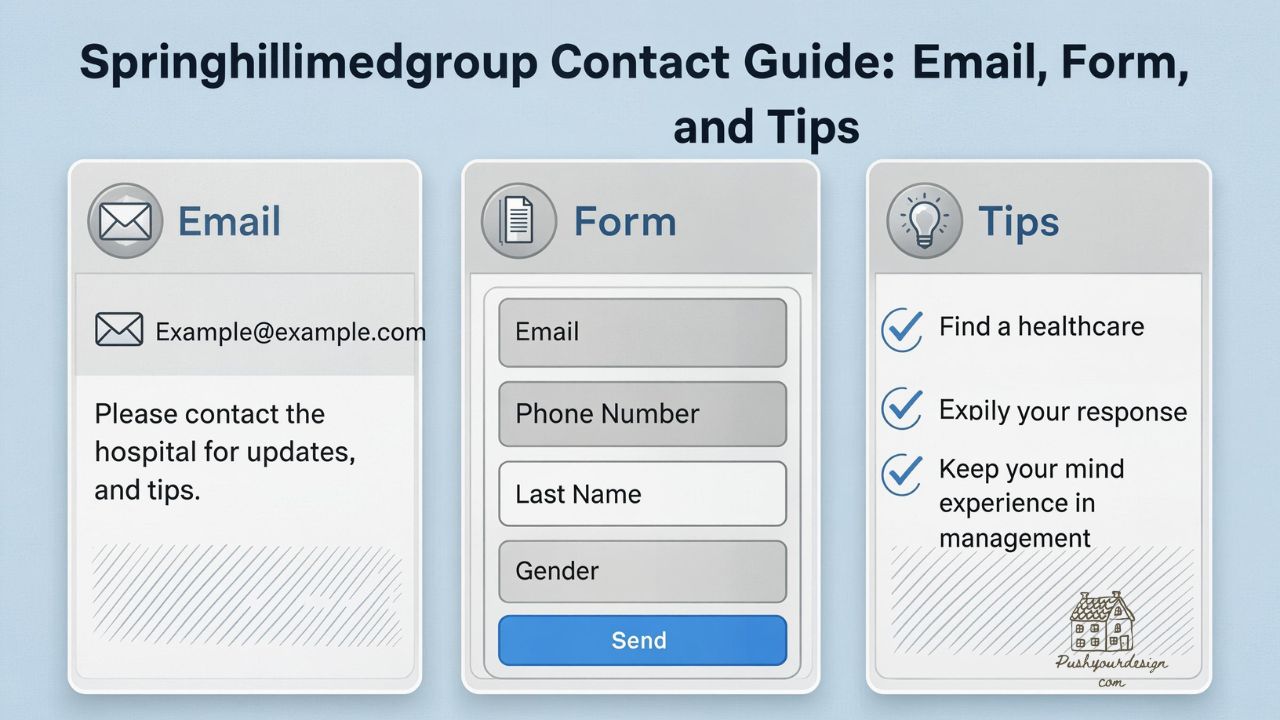
Image suggestion: Clean infographic titled “How to Contact Springhillmedgroup” with three blocks: email, contact form, and message checklist.
How to use springhillmedgroup contact the right way
A lot of people fail to get replies not because the contact information is wrong, but because the message itself is weak. If you want better results, your email should do three things quickly: identify who you are, explain why you are writing, and make the next step easy.
Write a strong subject line
The subject line should instantly tell the reader what your message is about. Avoid generic lines such as:
- Hello
- Need help
- Important message
- Business proposal
Instead, use something direct:
- Question about an article on Springhillmedgroup
- Partnership inquiry for springhillmedgroup.com
- Request to update published information
- Advertising inquiry for Springhillmedgroup
A good subject line improves the odds that your message is opened and routed correctly.
Mention the site name clearly
Because the site asks you to mention springhillmedgroup.com in the email body, do that near the start of your message.
A simple line works well:
“Hi, I’m reaching out regarding content published on springhillmedgroup.com.”
That small detail shows you followed the site’s own instruction.
Keep the first paragraph tight
Your opening paragraph should answer these questions in one short block:
- Who are you?
- Why are you contacting them?
- What do you need from them?
Example:
“Hello, my name is Sarah Khan, and I’m contacting springhillmedgroup.com regarding a recent article I read on your site. I have a question about the source information used in the post and would appreciate clarification.”
That is much stronger than writing a long introduction with no clear ask.
End with a clear action
Do not make the recipient guess what you want. End with a simple, polite next step:
- Please confirm whether this is the correct contact for editorial questions.
- Please let me know whether guest contribution inquiries are accepted.
- Please share the best person to speak with about this request.
Messages with one clear ask are easier to answer.
Best reasons to use springhillmedgroup contact
Not every reason for contacting a site is equally likely to get attention. Since Springhillmedgroup says it responds only to relevant propositions, it helps to stay within categories that make sense for the platform.
Here are some of the strongest reasons to reach out:
Questions about published content
If an article contains information you want clarified, corrected, or sourced, a direct and respectful inquiry makes sense. This is especially true for health-related reading, where readers often want better context before relying on a claim.
Editorial or business inquiries
If you want to discuss partnerships, media outreach, content collaboration, or another professional matter tied to the website, the public contact method is the logical starting point.
Reporting errors or broken pages
If a contact page, article link, image, or publication detail appears outdated, a short correction request may be helpful and relevant.
General site communication
Sometimes readers simply want to ask whether a certain topic has been covered, whether an article has an author contact, or whether the website accepts a particular kind of contribution.
What probably will not work well is sending unrelated spam, overly broad pitches, or personal medical case details that the site is not positioned to handle.
Image suggestion: Email mockup showing a well-written inquiry with labeled parts: subject, intro, purpose, and call to action.
Be careful with private health information
This part matters a lot. Because Springhillmedgroup is a health-themed site, some people may assume it is safe to send detailed medical information through a standard web form or regular email. That is not a good assumption to make.
The U.S. Department of Health and Human Services explains that the HIPAA Privacy Rule protects individually identifiable health information in covered settings, and the FTC also emphasizes privacy and security considerations when health information is collected, used, or shared.
The FTC also states that regular email is not a secure method for sending sensitive data and recommends encryption for transmissions containing information that could be misused.
So when using springhillmedgroup contact, do not include:
- full medical history
- lab reports
- prescription numbers
- ID documents
- insurance details
- payment card information
- highly sensitive personal data
A safer approach is to keep your first message general. Ask whether your issue belongs there, and wait for a proper next step. That protects your privacy and keeps your message more professional.
Is there a phone number for springhillmedgroup contact?
On the public contact page currently available, the main visible direct contact detail is the email address contact@springhillmedgroup.com. The page does not prominently list a public phone number in the contact details section the way many clinics or medical practices do.
This is another clue that the site may not be operating like a traditional local medical office. By contrast, a multispecialty provider such as Springhill Medical Group at springhillmed.com publicly highlights office calling information for telehealth and appointments.
That distinction is useful because people sometimes confuse similarly named websites. If you are looking for a doctor’s office, clinic scheduling desk, or location-based patient services, make sure you are contacting the correct organization and not a content site with a similar name.
How to tell whether you are contacting the right organization
This is one of the biggest reasons users get stuck. Similar names online can lead to the wrong email, wrong website, and wrong expectations.
Check the domain carefully
The contact page discussed here is on springhillmedgroup.com.
A different organization, springhillmed.com, appears to be a regional medical provider with location and appointment information.
Those are not the same domain, and the services presented on them are different.
Look at the homepage structure
Springhillmedgroup.com shows article categories, trending news, and wellness-style publishing sections.
If you expected patient portals, physician lists, appointment scheduling, or insurance instructions, that mismatch should tell you to double-check before sending sensitive information.
Read the contact language
The phrase about replying only to relevant propositions sounds more like a website or publication inbox than a patient communication line.
Small wording choices like that can save you a lot of confusion.
A simple email template you can use
Here is a polished template for springhillmedgroup contact that fits the site’s public guidance:
Subject: Question regarding content on Springhillmedgroup
Hello,
My name is [Your Name], and I’m reaching out regarding information published on springhillmedgroup.com.
I would like to ask about [brief reason in one sentence]. If this is the correct contact for this type of inquiry, I’d appreciate your guidance. If not, please let me know the best contact point.
Thank you for your time.
Best regards,
[Your Name]
[Your Email]
This works because it is respectful, direct, and easy to answer.
Common mistakes people make
Even when the springhillmedgroup contact details are correct, people often reduce their chances of getting a reply by making avoidable mistakes.
Writing too much
A long message with a buried question is hard to process. Aim for clarity, not length.
Being too vague
If the recipient cannot tell what you want in the first few lines, your message may be skipped.
Sending sensitive details too early
For privacy reasons, never assume a basic website inbox is the right place for confidential health records or personal documents.
Using a weak subject line
A vague subject can make even a relevant message look unimportant.
Contacting the wrong website
Because similar names exist online, always verify the domain before writing.
FAQ
What is the official springhillmedgroup contact email?
The public contact page for Springhillmedgroup lists contact@springhillmedgroup.com as the contact email.
Does Springhillmedgroup have a contact form?
Yes. The contact page includes a form with fields for first name, last name, email, subject, and message.
Should I mention the website name in my email?
Yes. The contact page specifically asks users to mention springhillmedgroup.com in the body of the email.
Is springhillmedgroup contact meant for appointments?
The public site structure suggests it functions more like a health and wellness content platform than a local appointment desk, so you should not assume it handles patient scheduling.
Is there a phone number listed for springhillmedgroup contact?
The public contact details section prominently lists an email address, but no clearly displayed phone number appears there.
Can I send medical records through the contact email?
That is not a good idea. HHS and the FTC both stress privacy and security concerns around health information, and the FTC notes that regular email is not a secure method for sensitive data.
Why might I not get a reply?
The contact page says the site receives many inquiries and can respond only to relevant propositions. A message that is unclear, unrelated, or too broad may not receive a response.
How can I improve my chances of getting a response?
Use a precise subject line, mention springhillmedgroup.com in the message body, explain your reason briefly, and end with one clear request. That approach aligns with the structure and wording shown on the site’s contact page.
Conclusion
Reaching out does not have to feel confusing when you know what the website actually offers. The public springhillmedgroup contact route is straightforward once you strip it down to the essentials: there is a contact form, there is a listed email address, and there is a clear hint that only relevant, well-written inquiries are likely to get attention.
The smartest approach is simple. Verify the domain, keep your message short, mention springhillmedgroup.com in the body, and avoid sending private medical details through ordinary email. Do that, and you give yourself the best chance of getting a useful response without unnecessary risk.